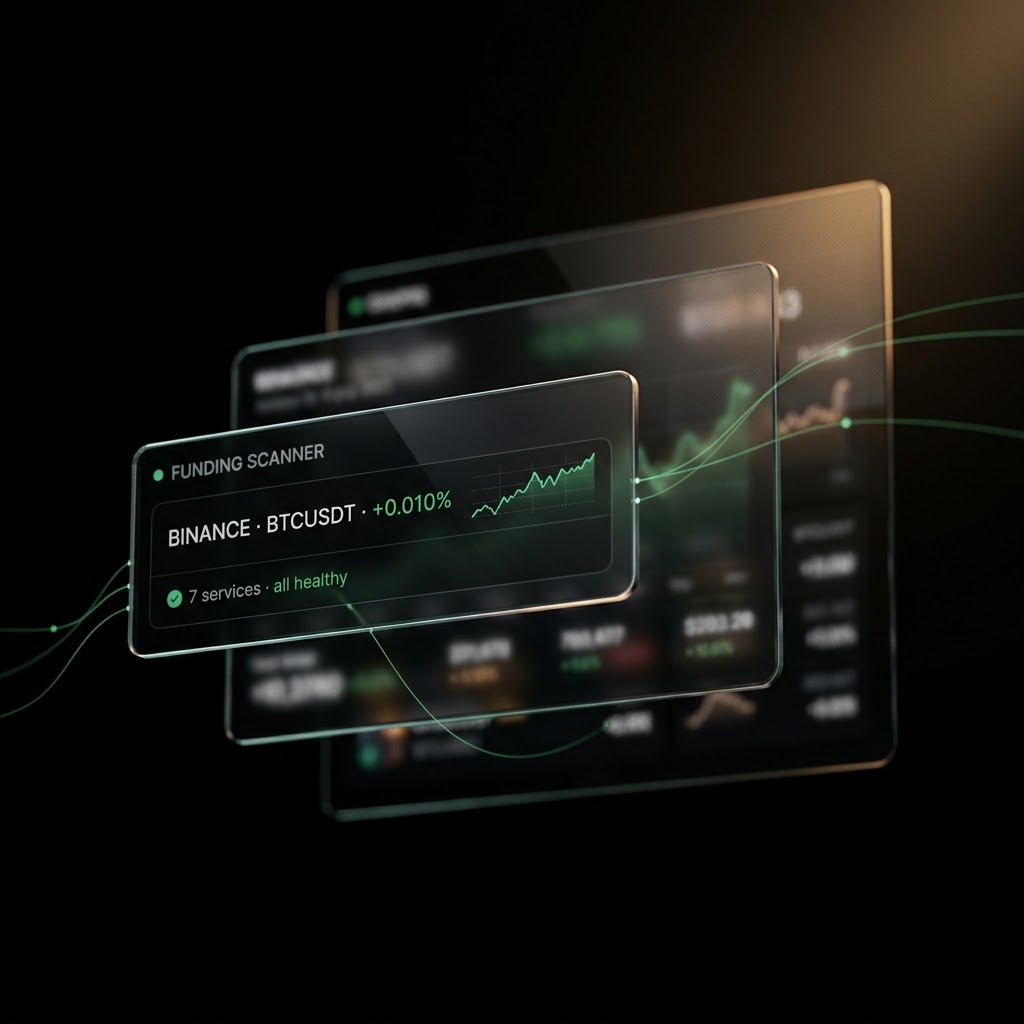
The expensive parts nobody is watching.
A websocket drops at 3am, reconnects, and nothing backfills the missing window. You discover it when a backtest gives a strange answer.
Depth data grows fast. Without partitioning and compression from day one, queries that took a second take a minute.
Naive polling gets you throttled at exactly the moment the market is interesting.
Silent failure is the normal failure mode. A service that stops and does not shout is worse than one that crashes.
Priced before anything starts.
Every project is quoted as a flat number after one conversation. No hourly billing, no scope creep, no invoice you did not expect.
First job, one problem, $250
Pick the single thing on this page that annoys you most. I fix that one, flat $250, so you can judge the work on something real before anything larger is discussed. Most clients start here.
Order book collector
$850Full depth capture with reconnect, sequence-gap detection and automatic backfill, stored so it stays queryable at volume.
Websocket ingestion
$650Trades, funding, liquidations and open interest across venues, continuously, with monitoring that notices silence.
Historical archive
$750Backfilled, deduplicated and indexed, in a schema built for the queries you actually run.
Latency monitoring
$350Continuous probes across exchange endpoints so you know which venue is slow before it costs you.
Bigger than this — full platforms, multi-venue pipelines, on-chain products — is quoted individually, typically $2,000 to $6,000.
Systems that are running right now.
Quant infrastructure
SEVEN SERVICES, ONE SERVERFunding scanner, basis collector, order book depth recorder, latency probe, listing watcher and paper portfolios, all under systemd.
Project Hunter
MARKET INTELLIGENCE SCANNEROHLCV on five timeframes, funding, open interest, liquidations over websocket, order book depth and CVD, feeding a signal engine with alerts and a live dashboard.
Tokino
SOLANA PREDICTION MARKETLive market settling real money. Migrated the production database off SQLite mid-flight, closed seven double-spend races in the settlement path.